Astute readers (and you -- singular -- know who you are!) will notice that I've chosen not to use a Roman numeral in my title. That's because this year the NFL has chosen not to use a Roman numeral in its naming of the Big Game. Super Bowl 50 on February 7, 2016, not Super Bowl L.
We have now gone beyond Deflategate, and are coming up upon the real thing--256 games of real pro football, followed by 11 playoff games. I for one am glad the legal wrangling is over, though Tom Brady again proved a major principle of American justice. If you have a wealthy lawyer, you can win anything in court. A guilty conscience, and friends with a pin to let the air out, are just not enough. Roger Goodell is a bigger loser than the Cleveland Browns (with their 24 starting quarterbacks since 1999).
With tonight's game between the Super Bowl champions almost a foregone conclusion (Patriots, zero suspensions, Steelers, two, plus All-Pro center Pouncey out; over/under for Patriots offense is 38), it's time for me to predict again the winners for the 2015 NFL season. But not before a look back.
As that great (former) football blogger Gregg Easterbrook wrote often, "All predictions wrong or your money back." Last year I only got five of 12 playoff teams correct. But, amazing of amazing, I did pick Brady & Belechik and company to win the Lombardi. And they did, in beyond-exciting fashion over the Seattle "I'll pass again and again on the one-yard line" Seahawks. My prediction was that the Patriots would beat the Saints. Ha! The Saints didn't even make the playoffs!
But then again, I predicted our Steelers would go 6-10, and a wonderful, bewildering season resulted in 11-5, more brilliance by Big Ben and Baby Bell, and a division championship over Baltimore and Cincinnati, which both crept into the January tourney as wild cards.
This year, again, I'm cannot be blinded by the offensive brilliance, Ben's magic touch, and Coach Tomlin's Tomlinisms. All I see is a defense that is at least one year away, and maybe three more skilled personnel additions, away from playoff caliber. Steelers, 7-9.
So here are my predictions for the 2015 NFL season:
NFC EAST: Eagles (3)
NFL NORTH: Packers (1)
NFC SOUTH: Saints (4)
NFC WEST: Seahawks (2)
Wild cards: Rams (6) and Cowboys (5)
Eagles over Rams
Saints over Cowboys
Packers over Saints
Eagles over Seahawks
Packers over Eagles
AFC EAST: Patriots (1)
AFC NORTH: Ravens (4)
AFC SOUTH: Colts (3)
AFC WEST: Chargers (2)
Wild Cards: Bills (6) and Broncos (5)
In such a super competitive league, I am picking the two Super Bowl participants to win their respective divisions. But I can't see either New England or Seattle making it back to Five-Oh in Santa Clara. Too many distractions, too great a possibility of the wrong injuries. The surprises in the league will be the Rams, making it back into the playoffs for the first time in more than a decade, similarly with the Bills. This will be the swan song for the great Peyton Manning, alas. And I think Aaron Rogers and Mike McCarthy (of St. Rosalia Parish, Pittsburgh, fame) will win their second big trophy.
Colts over Bills
Ravens over Broncos
Ravens over Patriots
Colts over Chargers
Colts over Ravens
SUPER BOWL 50: Packers over Colts
Thursday, September 10, 2015

Tuesday, August 18, 2015
Art and Fatih
Because of my education I usually and unconsciously join reading words and books with religious faith. The post-Vatican II era and the 20th and 21st centuries have brought unprecedented scholarship of the Word of God--the Hebrew and Christian scriptures which comprise the Bible. There are more working and publishing theologians today than in the entirety of the 2,000 years of the church. We listen to the teachings of Jesus in the gospels, read the writings of the popes and bishop and the reflections of the authentic spiritual writers of our day.
But I don't usually connect art and faith. To past generations, when only 1% or less of the population could read, faith was communicated through art. This was brought home to me many years ago when I met a priest who was the assistant director of the Basilica of the National Shrine of the Immaculate Conception in Washington, D.C. He described his church as "a catechism in stone and glass." That struck me. If you didn't know how to read, you could look at the stained glass images which portrayed scenes from the bible. You could see the images of the saints, through statues, frescoes or windows, with their symbols of faith: St. Peter and the keys of the kingdom; St. Paul and the sword of the word; St. Sebastian and his arrows; the Blessed Virgin Mary in all her cultural and maternal expressions.
There are 43 side altars in the Basilica representing various ethnic groups who have immigrated to our country. I remember the first time I took mom and dad to the Basilica, when I was studying at St. Mary's Seminary in Baltimore. Mom proudly dragged me to the Slovenian grotto and shrine in the crypt, with its image of Our Lady of Brezje (Mary our help). She told me how as a young girl her Slovenian pastor at St. Mary Assumption Parish, 57th street in the Lawrenceville neighborhood of Pittsburgh, took up collections from the poor parishioners, and sent the money to Washington for the creation of this small but exquisite altar and image.

When taking the tour of the museum of Melk Abbey, on the Danube River in Austria, we saw many beautiful and historic pieces of art.
Melk Cross, 1362

"Ecce Homo," 1502

St. Kolomon monstrance, 1752

But one image caught my eye, and the eye of faith. It is a wooden crucifix, from the 12th century, done by an unknown woodcarver.


Somehow this image struck me. How many folks--monks, abbots, townspeople, emperors, poor people--gazed on this image of Christ on the cross? What did they think? What did they feel? Did they see the sacrifice of his life in this stylized image? Did they come closer to knowing Christ as their savior, their helper, their God?
What images of art touch you? Do any of them lead you to deeper faith in God--Father, Son and Spirit?
But I don't usually connect art and faith. To past generations, when only 1% or less of the population could read, faith was communicated through art. This was brought home to me many years ago when I met a priest who was the assistant director of the Basilica of the National Shrine of the Immaculate Conception in Washington, D.C. He described his church as "a catechism in stone and glass." That struck me. If you didn't know how to read, you could look at the stained glass images which portrayed scenes from the bible. You could see the images of the saints, through statues, frescoes or windows, with their symbols of faith: St. Peter and the keys of the kingdom; St. Paul and the sword of the word; St. Sebastian and his arrows; the Blessed Virgin Mary in all her cultural and maternal expressions.
There are 43 side altars in the Basilica representing various ethnic groups who have immigrated to our country. I remember the first time I took mom and dad to the Basilica, when I was studying at St. Mary's Seminary in Baltimore. Mom proudly dragged me to the Slovenian grotto and shrine in the crypt, with its image of Our Lady of Brezje (Mary our help). She told me how as a young girl her Slovenian pastor at St. Mary Assumption Parish, 57th street in the Lawrenceville neighborhood of Pittsburgh, took up collections from the poor parishioners, and sent the money to Washington for the creation of this small but exquisite altar and image.

When taking the tour of the museum of Melk Abbey, on the Danube River in Austria, we saw many beautiful and historic pieces of art.
Melk Cross, 1362

"Ecce Homo," 1502

St. Kolomon monstrance, 1752

But one image caught my eye, and the eye of faith. It is a wooden crucifix, from the 12th century, done by an unknown woodcarver.


Somehow this image struck me. How many folks--monks, abbots, townspeople, emperors, poor people--gazed on this image of Christ on the cross? What did they think? What did they feel? Did they see the sacrifice of his life in this stylized image? Did they come closer to knowing Christ as their savior, their helper, their God?
What images of art touch you? Do any of them lead you to deeper faith in God--Father, Son and Spirit?
Churches of Eastern Europe - IV
Huge churches, like large corporations, great countries and complex universities, seem to have "always been there." But you don't have to be a scholar of history to realize that these institutions have humble beginnings, growth spurts, downturns, even coming close to dissolution.
Think about American corporations which were at one time immense, and no longer exist (Compaq, Enron, Woolworth, Standard Oil, Arthur Anderson, E.F. Hutton and many airlines--Eastern, Pan Am, TWA, USAir). Think about the humble beginnings of our own country, and that we have only been a world power post-World War II. Think about the handful of students who were taught in 1789, which over two centuries became the University of Pittsburgh.
Monasteries are similar, with rises and falls bigger than a roller coaster.
Such was the case with the Melk Abbey (Stift Melk) in the Wachau Valley of the Danube River, currently governed by Austria.
Our floating hotel, the Viking Prestige, coasted for two hours through the Wachau Valley, with its steep hillsides filled with abundant vineyards, occasional manors and the odd abandoned, crumbling castle. It was sunny and warm, and almost every passenger was on the sun deck taking pictures and enjoying the gentle river cruising. We came to a confluence of three rivers, the Melk and the Pietach flowing into the Danube. Towering over the small town and the river valley is the Melk Abbey.


Archaeologists note that human habitation of this site goes back to the Stone, Bronze and Iron Ages. During the Roman Empire there was a small fort. Christianity came to the region sometime in the 8th century. Charlemagne allegedly was in Melk about the year 791. The bishops of Eichstatt, Passau and Salzburg were involved in pastoral care of towns in the area during the 9th and 10th century.
The actual date of the first monastery in Melk is shrouded by history, but dates at least to 831, perhaps earlier. It is known that by 960 Melk was one of several "marks," that is, a territorial organization designed for defense by the local ruler. According to the history booklet "Stift Melk," a mark was "a fortress, not only a military center, but a spiritual [parish] and economic [markets were held next to the fortress] center as well."
Benedictine monks supplanted the canons regular living on the cliff above the river and began the Melk Abbey we we know it on March 21, 1089. The Melk library still has the venerable copy of the Rule of St. Benedict which the monks brought with them from Lambach.
Here is where the roller coaster begins. Over the next millennium, the abbey rose and fell, according the leadership quality of the abbot, the presence or absence of war, and the vagaries of fire. A massive church was constructed on the site, and a school dates from at least 1160. In the 14th and 15th centuries the abbey was in great decline, at one time comprised of only three priests and two brothers. Duke Albrecht V and Abbot Nikolaus Sayringer began a reform which brought the abbey out of debt, and more importantly, brought new men, clear vision and orthodoxy to the monastery. A new church was consecrated in 1429. This church was torn down and a new, Baroque church begun in 1702 by Abbot Berthold Dietmayr, who governed for 39 years. It is this church which we were privileged to see.

One definition of "baroque" is "extravagantly ornate, florid and convoluted in style." The Melk Abbey and Church is certainly that. You are overwhelmed by the size of statues, brilliant colors, exaggerated poses of figures, and overall impression of artists who were on drugs when they designed and executed their work. A contemporary restoration (1978-87) has brought light and shine to every altar, fresco and statue. Take a look at these images.


This is the ceiling of the church.
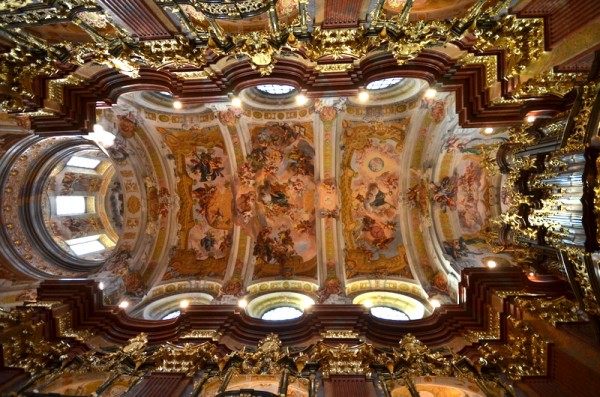
The library and the Marble Room were also incredible feasts for the eye. Here is the frescoed ceiling of the Marble Room.


One short blog post cannot do justice to this site of beauty, prayer and faith. We were able to give several hours to the tour of Melk Abbey and Church, and I am glad we did.
Think about American corporations which were at one time immense, and no longer exist (Compaq, Enron, Woolworth, Standard Oil, Arthur Anderson, E.F. Hutton and many airlines--Eastern, Pan Am, TWA, USAir). Think about the humble beginnings of our own country, and that we have only been a world power post-World War II. Think about the handful of students who were taught in 1789, which over two centuries became the University of Pittsburgh.
Monasteries are similar, with rises and falls bigger than a roller coaster.
Such was the case with the Melk Abbey (Stift Melk) in the Wachau Valley of the Danube River, currently governed by Austria.
Our floating hotel, the Viking Prestige, coasted for two hours through the Wachau Valley, with its steep hillsides filled with abundant vineyards, occasional manors and the odd abandoned, crumbling castle. It was sunny and warm, and almost every passenger was on the sun deck taking pictures and enjoying the gentle river cruising. We came to a confluence of three rivers, the Melk and the Pietach flowing into the Danube. Towering over the small town and the river valley is the Melk Abbey.


Archaeologists note that human habitation of this site goes back to the Stone, Bronze and Iron Ages. During the Roman Empire there was a small fort. Christianity came to the region sometime in the 8th century. Charlemagne allegedly was in Melk about the year 791. The bishops of Eichstatt, Passau and Salzburg were involved in pastoral care of towns in the area during the 9th and 10th century.
The actual date of the first monastery in Melk is shrouded by history, but dates at least to 831, perhaps earlier. It is known that by 960 Melk was one of several "marks," that is, a territorial organization designed for defense by the local ruler. According to the history booklet "Stift Melk," a mark was "a fortress, not only a military center, but a spiritual [parish] and economic [markets were held next to the fortress] center as well."
Benedictine monks supplanted the canons regular living on the cliff above the river and began the Melk Abbey we we know it on March 21, 1089. The Melk library still has the venerable copy of the Rule of St. Benedict which the monks brought with them from Lambach.
Here is where the roller coaster begins. Over the next millennium, the abbey rose and fell, according the leadership quality of the abbot, the presence or absence of war, and the vagaries of fire. A massive church was constructed on the site, and a school dates from at least 1160. In the 14th and 15th centuries the abbey was in great decline, at one time comprised of only three priests and two brothers. Duke Albrecht V and Abbot Nikolaus Sayringer began a reform which brought the abbey out of debt, and more importantly, brought new men, clear vision and orthodoxy to the monastery. A new church was consecrated in 1429. This church was torn down and a new, Baroque church begun in 1702 by Abbot Berthold Dietmayr, who governed for 39 years. It is this church which we were privileged to see.

One definition of "baroque" is "extravagantly ornate, florid and convoluted in style." The Melk Abbey and Church is certainly that. You are overwhelmed by the size of statues, brilliant colors, exaggerated poses of figures, and overall impression of artists who were on drugs when they designed and executed their work. A contemporary restoration (1978-87) has brought light and shine to every altar, fresco and statue. Take a look at these images.


This is the ceiling of the church.
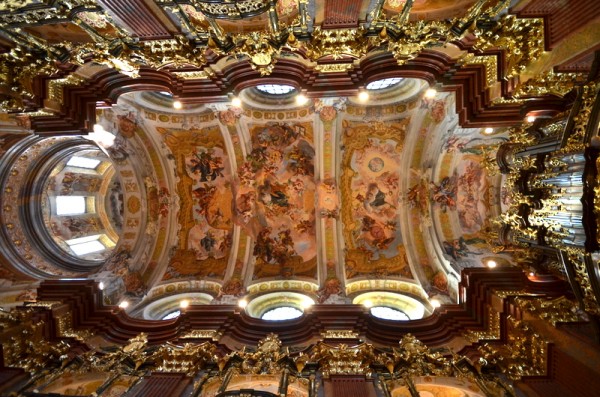
The library and the Marble Room were also incredible feasts for the eye. Here is the frescoed ceiling of the Marble Room.


One short blog post cannot do justice to this site of beauty, prayer and faith. We were able to give several hours to the tour of Melk Abbey and Church, and I am glad we did.
Thursday, August 13, 2015
Schutzmantelmadonna
As I was working up the previous post on St. Stephan's Cathedral in Vienna, I came across a particular image of the Blessed Virgin Mary in my helpful color booklet. She is "Protective Mantle Madonna," "Schutzmantelmadonna" in German.

Let me quote from the booklet:
Mary with Child -- beneath her cloak, people of various walks of life seek refuge. Since about the mid-13th century, there have been depictions availing themselves of the legal symbol of the protective mantle in order to express redemptive safety. The oldest prayer to Mary handed down to us, discovered on a 3rd century Coptic papyrus found in the desert sands and still used today in Eastern Orthodox Litany, runs, "We flee into your mercy, Holy Mother, do not spurn our prayer in need, but save us from danger, O immaculate and blessed Mary, full of grace."
Mary stands as "Theodokos," that is, "Mother of God," in the center of saintly adoration -- but only because in her role as Holy Mother, mother of life, special reverence is due her, and through her the miraculous ways of God and Jesus are honored.
There are actually 96 representations of Mary in St. Stephan's Cathedral in Vienna, and at least three of them are "Protective-Mantle Madonnas." I found these representations of the similar image of Mary on the net.


I find this image strangely attractive and touching. The extension of Mary's arms brings to mind the contemporary hymn, "All Are Welcome." The first image--from St. Stephan's Cathedral--depicts Mary with a very human and kindly face.
My first thought in looking at this is that this is a visual representation of the Vatican II understanding of the church as the People of God. All are gathered under the mantle of the Mother of Jesus, the first to hear the Word of God. My second thought is to double down on the "mantle," and recall the Virgin of Guadalupe. She imprinted her own image on the mantle (tilma), the rough cloak of Juan Diego in 1531.

A third connection is Mary as mother of mercy. This fits very well with Pope Francis's call for an Extraordinary Jubilee Year of Mercy.
In his bull announcing the Jubilee Year, Misericordiae Vultus, Francis writes, "My thoughts now turn to the Mother of Mercy. May the sweetness of her countenance watch over us in this Holy Year, so that all of us may rediscover the joy of God's tenderness. No one has penetrated the profound mystery of the incarnation like Mary. Her entire life was patterned after the presence of mercy made flesh. The Mother of the Crucified and Risen One has entered the sanctuary of divine mercy because she participated intimately in the mystery of His love....
"Mary attests that the mercy of the Son of God knows no bounds and extends to everyone, without exception. Let us address her in the words of the Salve Regina, a prayer ever ancient and ever new, so that she may never tire of turning her merciful eyes upon us, and make us worthy to contemplate the face of mercy, her Son Jesus." (#24)
Perhaps you have seen this particular image of Protective Mantle Madonna in other churches. If so, let me know.

Let me quote from the booklet:
Mary with Child -- beneath her cloak, people of various walks of life seek refuge. Since about the mid-13th century, there have been depictions availing themselves of the legal symbol of the protective mantle in order to express redemptive safety. The oldest prayer to Mary handed down to us, discovered on a 3rd century Coptic papyrus found in the desert sands and still used today in Eastern Orthodox Litany, runs, "We flee into your mercy, Holy Mother, do not spurn our prayer in need, but save us from danger, O immaculate and blessed Mary, full of grace."
Mary stands as "Theodokos," that is, "Mother of God," in the center of saintly adoration -- but only because in her role as Holy Mother, mother of life, special reverence is due her, and through her the miraculous ways of God and Jesus are honored.
There are actually 96 representations of Mary in St. Stephan's Cathedral in Vienna, and at least three of them are "Protective-Mantle Madonnas." I found these representations of the similar image of Mary on the net.


I find this image strangely attractive and touching. The extension of Mary's arms brings to mind the contemporary hymn, "All Are Welcome." The first image--from St. Stephan's Cathedral--depicts Mary with a very human and kindly face.
My first thought in looking at this is that this is a visual representation of the Vatican II understanding of the church as the People of God. All are gathered under the mantle of the Mother of Jesus, the first to hear the Word of God. My second thought is to double down on the "mantle," and recall the Virgin of Guadalupe. She imprinted her own image on the mantle (tilma), the rough cloak of Juan Diego in 1531.

A third connection is Mary as mother of mercy. This fits very well with Pope Francis's call for an Extraordinary Jubilee Year of Mercy.
In his bull announcing the Jubilee Year, Misericordiae Vultus, Francis writes, "My thoughts now turn to the Mother of Mercy. May the sweetness of her countenance watch over us in this Holy Year, so that all of us may rediscover the joy of God's tenderness. No one has penetrated the profound mystery of the incarnation like Mary. Her entire life was patterned after the presence of mercy made flesh. The Mother of the Crucified and Risen One has entered the sanctuary of divine mercy because she participated intimately in the mystery of His love....
"Mary attests that the mercy of the Son of God knows no bounds and extends to everyone, without exception. Let us address her in the words of the Salve Regina, a prayer ever ancient and ever new, so that she may never tire of turning her merciful eyes upon us, and make us worthy to contemplate the face of mercy, her Son Jesus." (#24)
Perhaps you have seen this particular image of Protective Mantle Madonna in other churches. If so, let me know.
Churches of Eastern Europe - III
The third city on our Danube cruise, and the third capital city, was Vienna, Austria. Our ship, the Viking Prestige, docked next to another sister ship, the Viking Freya. And I mean next to--try three inches. We had to pass through the small entrance of the Freya to make our way onto the wide concrete dock, where buses would take us into the city.
Seventy years after the end of World War Two Vienna looks decidedly prosperous. Huge Gothic government buildings were under renovation. The University of Vienna, founded 650 years ago, is filled with beautiful buildings and waves of designer-jean-clad young people. The subway system is modern, clean and efficient. (You can see a brief scene of the Vienna subway in the just released Tom Cruise thriller, Mission Impossible: Rogue Nation. As I watched the movie, I smiled and thought, hey, I was on that platform!)
After a three hour bus tour of the city, my friends Jackie, Alice and I decided not to take the bus back to our floating hotel. Rather, we departed in the center of the city and enjoyed strolling in the sunshine. Jackie bought two stylish G. Klink scarfs, I bought post-cards, and we found the stuffy Sacher Hotel. There we ordered lunch, and for dessert enjoyed the world famous Sacher Torte--chocolate cake with whipped cream. Despite the obvious fact of our American tourist look, the wait staff was kind and cheerful.
Before we headed back to the ship via the subway system, we entered St. Stephan's Cathedral (Stephansdom). People were coming and going throughout the church, so that it was packed with noisy crowds and many families with little children. It was also dark. Portions of the church nearer the altar and sanctuary were roped off to us hoi polloi. These spaces were only open and available for visitors if you paid for a church-sponsored tour. I confess that both on the inside and the outside I didn't appreciate St. Stephan's beauty. From the inside it was dark. The outside had a very small square, which didn't give a proper perspective on the roof or the two smaller towers and one large tower.

I did manage to get an English language copy of a tour book of the Cathedral. I've found these glossy paper, full color booklets (usually available for 7 or 8 euros) an excellent way to get superb photographs of both the big picture and the little details of the church. They also give more detail about the history and architecture of the building than you could ever get from a human guide. What I say here mostly comes from the booklet.

The origins of St. Stephen's goes back to 1147, when the reigning diocese was Passau, further up the Danube River. Over the centuries a church grew, according to the periods of peace between wars. This building was only consecrated in 1263, in a late Romanesque style. Various expansions over the next centuries brought about a choir and several towers in the Baroque style. The diocese of Vienna was established in 1469, with St. Stephan's now designated the cathedral. Wars with the Turks in the 16th and 17th centuries left their mark in cannon balls in the walls, and long stretches where no construction was done on the building.

At the end of World War Two (April 11 and 12, 1945), fires in surrounding buildings lept onto the church and destroyed 45% of the cathedral, including all of the 19th century stained glass windows and many treasures. The bishop, Cardinal Theodor Innitzer, was "unflagging" in his determination to rebuild St. Stephan's Cathedral. A solemn inauguration of the rebuilt cathedral was held a remarkable seven years later, in 1952; new bells installed in 1960; and Pope (Saint) John Paul II paid two pastoral visits in 1983 and 1988.

There is no way I can do justice to the symbolism, architectural styles, statues of over 100 saints, or historic treasures in St. Stephan's Cathedral. Here is just one example from the booklet:
Seven is a sacred number representing perfection. Recall the seven sacrament of the Catholic Church or the seven original church deacons -- one of whom was St. Stephan -- or the Book of the Apocalypse with its seven seals.
Based on the numbers three and four,the dimensions of the cathedral can be calculated rather precisely: placing a seven after the three results in the number 37. Three times 37 results in three times the one, namely, 111.
The cathedral's breadth is 111 feet. Three times 111 -- 333 feet -- constitutes the length of the cathedral. four times 111 -- 444 feet -- is the height of the South Tower. Seven times seven times seven -- 343 -- is the number of steps leading to the tower chamber of the high tower.
In 1457 Aeneas Silvio Picolomini, an adviser to Emperor Friedrich III, who would later become Pope Pius III, wrote, "St. Stephan's Cathedral is far more magnificent than could ever be expressed in words." To which I say, Amen.

Seventy years after the end of World War Two Vienna looks decidedly prosperous. Huge Gothic government buildings were under renovation. The University of Vienna, founded 650 years ago, is filled with beautiful buildings and waves of designer-jean-clad young people. The subway system is modern, clean and efficient. (You can see a brief scene of the Vienna subway in the just released Tom Cruise thriller, Mission Impossible: Rogue Nation. As I watched the movie, I smiled and thought, hey, I was on that platform!)
After a three hour bus tour of the city, my friends Jackie, Alice and I decided not to take the bus back to our floating hotel. Rather, we departed in the center of the city and enjoyed strolling in the sunshine. Jackie bought two stylish G. Klink scarfs, I bought post-cards, and we found the stuffy Sacher Hotel. There we ordered lunch, and for dessert enjoyed the world famous Sacher Torte--chocolate cake with whipped cream. Despite the obvious fact of our American tourist look, the wait staff was kind and cheerful.
Before we headed back to the ship via the subway system, we entered St. Stephan's Cathedral (Stephansdom). People were coming and going throughout the church, so that it was packed with noisy crowds and many families with little children. It was also dark. Portions of the church nearer the altar and sanctuary were roped off to us hoi polloi. These spaces were only open and available for visitors if you paid for a church-sponsored tour. I confess that both on the inside and the outside I didn't appreciate St. Stephan's beauty. From the inside it was dark. The outside had a very small square, which didn't give a proper perspective on the roof or the two smaller towers and one large tower.

I did manage to get an English language copy of a tour book of the Cathedral. I've found these glossy paper, full color booklets (usually available for 7 or 8 euros) an excellent way to get superb photographs of both the big picture and the little details of the church. They also give more detail about the history and architecture of the building than you could ever get from a human guide. What I say here mostly comes from the booklet.

The origins of St. Stephen's goes back to 1147, when the reigning diocese was Passau, further up the Danube River. Over the centuries a church grew, according to the periods of peace between wars. This building was only consecrated in 1263, in a late Romanesque style. Various expansions over the next centuries brought about a choir and several towers in the Baroque style. The diocese of Vienna was established in 1469, with St. Stephan's now designated the cathedral. Wars with the Turks in the 16th and 17th centuries left their mark in cannon balls in the walls, and long stretches where no construction was done on the building.

At the end of World War Two (April 11 and 12, 1945), fires in surrounding buildings lept onto the church and destroyed 45% of the cathedral, including all of the 19th century stained glass windows and many treasures. The bishop, Cardinal Theodor Innitzer, was "unflagging" in his determination to rebuild St. Stephan's Cathedral. A solemn inauguration of the rebuilt cathedral was held a remarkable seven years later, in 1952; new bells installed in 1960; and Pope (Saint) John Paul II paid two pastoral visits in 1983 and 1988.

There is no way I can do justice to the symbolism, architectural styles, statues of over 100 saints, or historic treasures in St. Stephan's Cathedral. Here is just one example from the booklet:
Seven is a sacred number representing perfection. Recall the seven sacrament of the Catholic Church or the seven original church deacons -- one of whom was St. Stephan -- or the Book of the Apocalypse with its seven seals.
Based on the numbers three and four,the dimensions of the cathedral can be calculated rather precisely: placing a seven after the three results in the number 37. Three times 37 results in three times the one, namely, 111.
The cathedral's breadth is 111 feet. Three times 111 -- 333 feet -- constitutes the length of the cathedral. four times 111 -- 444 feet -- is the height of the South Tower. Seven times seven times seven -- 343 -- is the number of steps leading to the tower chamber of the high tower.
In 1457 Aeneas Silvio Picolomini, an adviser to Emperor Friedrich III, who would later become Pope Pius III, wrote, "St. Stephan's Cathedral is far more magnificent than could ever be expressed in words." To which I say, Amen.

Excellence in Catholic Education
The new school year is almost upon us. Each year the Pittsburgh Catholic does a back-to-school supplement. Somehow I got asked to do a column on "Excellence in Catholic Education" for this supplement. I could have praised the test scores, faculty, curricula, extracurricular activities, and rich Christian atmosphere of our Catholic elementary schools. But I thought I'd take the idea in another direction. (This will also be my column in our New Castle parish bulletin for August 30.)
A few years ago Catholic elementary schools touted their excellence with the slogan, "Where great beginnings last a lifetime." And it's true. The students in our Catholic schools, at St. Vitus School, in this diocese and throughout the U.S., have achieved an unparalleled record of academic excellence. Alumni have and continue to go on to rewarding careers as parents, businesspersons, doctors, lawyers, soldiers, office and factory workers, professors, even priests, deacons and members of religious communities.

To reach these heights our grads have continued their education, receiving advanced degrees in a wide variety of disciplines. But somewhere along the way Catholic educators and we pastors have failed to communicate adequately that all our young people are in the "school of continual faith formation" as well. The Catholic faith they received in baptism, Holy Communion and Confirmation necessarily is only fulfilled by a lifetime of attention and commitment.
The path from childhood faith to adult faith is fraught with difficulties. During the college years young people are exposed to a wide range of ideas and philosophies, many skeptical of Christianity. During the young adult years dating and decisions about sexuality and the permanence of marriage are important. The challenging perspective of Jesus's teachings often get lost in a "just do it" or "whatever" culture. Young adults soon learn God does not strike them dead if they miss Mass on Sunday. Then one Sunday turns into a month of Sundays. Some of their friends may espouse the old canard that "all religions are the same," which is code language for "don't bother with practicing your Catholicism."
All of these barriers to the active practice of the Catholic faith need to be addressed in the school of continuing faith formation. But not in an actual school building. Adults learn differently than children. Adults need to be engaged. Adults learn by participating. Their questions are just as important as accurate answers.
Parishes and faith communities which have success in facilitating the transition from childhood faith to adult practice use a variety of methods. One sure way is inviting folks to volunteer for a ministry. It could be as a lector or extraordinary Eucharistic minister, a helper in the parish festival or aide in the youth ministry. Our parishes benefit from young adults invited to serve on the pastoral and finance councils, as well as in the Knights of Columbus, St. Vincent de Paul Society, or Catholic men's fellowship.

Another popular route to faith engagement is adult bible study. No one has to be a scholar to sit down with other interested adults, share their experiences and feelings, and reflect deeply on the riches of one of the Gospels or another biblical book. In these bible studies the ups and downs of ordinary life meet the living and nourishing Word of God.
Retreats and days of reflection--time away from the busyness of life--help Christians of all ages grow in prayer and the infinite value of the Eucharist.
I've been blessed to walk with couples who reflect on the graces of the sacrament of Matrimony through Teams of Our Lady. Our monthly gatherings of supper, prayer and discussion, bolstered by praying the Magnificat daily, open up new vistas in how they meet Christ in and through their marriage and family. Participation in similar lay ecclesial movements, such as Cursillo, the Christ Child Society, the Ladies of Charity, Marriage Encounter, Pax Christi and the Serra Club, can nourish and help us to grow in the Catholic faith.
Excellence in Catholic education means more than just outstanding Catholic elementary and high schools, more than exceptional C.C.D. programs for youth. Excellence in Catholic education invites us to be lifelong inter-generational, multi-faceted learners. Excellence in Catholic education means all of us, called by God in faith to be disciples of Jesus Christ, invest our hearts and minds in the pursuit of living daily the two great commandments, love of God and love of neighbor, "growing in every way into him who is the head, Christ" (Ephesians 4:15).

A few years ago Catholic elementary schools touted their excellence with the slogan, "Where great beginnings last a lifetime." And it's true. The students in our Catholic schools, at St. Vitus School, in this diocese and throughout the U.S., have achieved an unparalleled record of academic excellence. Alumni have and continue to go on to rewarding careers as parents, businesspersons, doctors, lawyers, soldiers, office and factory workers, professors, even priests, deacons and members of religious communities.
To reach these heights our grads have continued their education, receiving advanced degrees in a wide variety of disciplines. But somewhere along the way Catholic educators and we pastors have failed to communicate adequately that all our young people are in the "school of continual faith formation" as well. The Catholic faith they received in baptism, Holy Communion and Confirmation necessarily is only fulfilled by a lifetime of attention and commitment.
The path from childhood faith to adult faith is fraught with difficulties. During the college years young people are exposed to a wide range of ideas and philosophies, many skeptical of Christianity. During the young adult years dating and decisions about sexuality and the permanence of marriage are important. The challenging perspective of Jesus's teachings often get lost in a "just do it" or "whatever" culture. Young adults soon learn God does not strike them dead if they miss Mass on Sunday. Then one Sunday turns into a month of Sundays. Some of their friends may espouse the old canard that "all religions are the same," which is code language for "don't bother with practicing your Catholicism."
All of these barriers to the active practice of the Catholic faith need to be addressed in the school of continuing faith formation. But not in an actual school building. Adults learn differently than children. Adults need to be engaged. Adults learn by participating. Their questions are just as important as accurate answers.
Parishes and faith communities which have success in facilitating the transition from childhood faith to adult practice use a variety of methods. One sure way is inviting folks to volunteer for a ministry. It could be as a lector or extraordinary Eucharistic minister, a helper in the parish festival or aide in the youth ministry. Our parishes benefit from young adults invited to serve on the pastoral and finance councils, as well as in the Knights of Columbus, St. Vincent de Paul Society, or Catholic men's fellowship.
Another popular route to faith engagement is adult bible study. No one has to be a scholar to sit down with other interested adults, share their experiences and feelings, and reflect deeply on the riches of one of the Gospels or another biblical book. In these bible studies the ups and downs of ordinary life meet the living and nourishing Word of God.
Retreats and days of reflection--time away from the busyness of life--help Christians of all ages grow in prayer and the infinite value of the Eucharist.
I've been blessed to walk with couples who reflect on the graces of the sacrament of Matrimony through Teams of Our Lady. Our monthly gatherings of supper, prayer and discussion, bolstered by praying the Magnificat daily, open up new vistas in how they meet Christ in and through their marriage and family. Participation in similar lay ecclesial movements, such as Cursillo, the Christ Child Society, the Ladies of Charity, Marriage Encounter, Pax Christi and the Serra Club, can nourish and help us to grow in the Catholic faith.
Excellence in Catholic education means more than just outstanding Catholic elementary and high schools, more than exceptional C.C.D. programs for youth. Excellence in Catholic education invites us to be lifelong inter-generational, multi-faceted learners. Excellence in Catholic education means all of us, called by God in faith to be disciples of Jesus Christ, invest our hearts and minds in the pursuit of living daily the two great commandments, love of God and love of neighbor, "growing in every way into him who is the head, Christ" (Ephesians 4:15).

Thursday, July 2, 2015
Changes Local and Regional
As I mentioned in my previous post, our neighboring parishes of Christ the King, Bessemer-Hillsville, and St. James the Apostle, Pulaski, here in Lawrence County are receiving a deacon as administrator, John Carran, effective July 27. This follows the retirement of Father Jim Downs later this month.
Deacon administrators are one of several strategies which the Diocese of Pittsburgh is using to address the decline in the number of available active priests. Other pastoral strategies are one pastor for multiple parishes (like what yours truly is doing in the city of New Castle), sharing pastoral staff, collaboration among parishes in various ministries, team ministry, a woman religious as "parish life collaborator," increased prayer for all vocations, including to the priesthood, and reducing the number of scheduled Sunday Masses in parishes. I suspect that next year a couple more deacons may be appointed to full-time administration of parishes, and after them down the road, a few layfolk as well.
This is the negative dimension of On Mission for the Church Alive, which is the diocesan-wide planning process for all our parishes we are undergoing. Many of our parishioners are having a hard time dealing with this. In our four parishes we have received over 425 written responses to our invitation to consultation regarding a new Sunday Mass schedule. Most of them are in the vein of "take a Mass from their parish, not from my parish." I hosted an open house on Tuesday, June 30, at St. Joseph the Worker church hall. This was an opportunity for parishioners to come and express their opinion. And they did! Over 75 people came, and many spoke. Most of the questions were really sermons, saying we want to keep things in our parish as they are.
I reiterated the fact that where right now we have five priests to cover seven parishes, celebrating 20 Sunday Masses, at of the end of the month we will have only four priests for these same parishes, celebrating maybe 13 or 14 Sunday Masses. They reiterated their self-interest.
I get it. Change is hard. Folks say to me, in effect, Father, there are so many changes in the world, why can't the Church be immune to change? And I respond, we the church are also part of the world. We have to change, too.
Actually, I thought just about everyone who turned out on Tuesday night were civil and understanding of the big picture. Several quietly said to me, "It'll be OK, Father. We'll get through this. We support you, and know you're only doing what you have to."
The big picture is a positive message. This is the bishop's call to be a truly evangelical church, to reach out, to invite, to call again the people to the person and love of Jesus Christ. Whether you reference the many initiatives of Peter and Paul and other disciples in the Acts of the Apostles, or Matthew 28:19 ("Go teach all nations, baptizing them in the name of the Father, and of the Son, and of the Holy Spirit"), the aspect of mission is fundamental to the church. As one theologian says, the church doesn't have a mission, the mission of Christ has a church to enact it.
What is hard is to address both of these perspectives in our planning and ministry. F. Scott Fitzgerald is quoted as saying, "The test of a first-rate intelligence is the ability to hold two opposed ideas in the mind at the same time, and still retain the ability to function." I know that I have a tendency, usually unconscious, to address the negative. I know, too, that most people are comfortable only talking about the positive. How do you keep both before you?
This is the challenge of Bishop Zubik's call for On Mission for the Church Alive -- to address the realities for our parishes and institutional structures of fewer priests and fewer parishioners, while as the same time to look forward and plan to enact a future with hope of spiritual growth for our communities of faith.
Deacon administrators are one of several strategies which the Diocese of Pittsburgh is using to address the decline in the number of available active priests. Other pastoral strategies are one pastor for multiple parishes (like what yours truly is doing in the city of New Castle), sharing pastoral staff, collaboration among parishes in various ministries, team ministry, a woman religious as "parish life collaborator," increased prayer for all vocations, including to the priesthood, and reducing the number of scheduled Sunday Masses in parishes. I suspect that next year a couple more deacons may be appointed to full-time administration of parishes, and after them down the road, a few layfolk as well.
This is the negative dimension of On Mission for the Church Alive, which is the diocesan-wide planning process for all our parishes we are undergoing. Many of our parishioners are having a hard time dealing with this. In our four parishes we have received over 425 written responses to our invitation to consultation regarding a new Sunday Mass schedule. Most of them are in the vein of "take a Mass from their parish, not from my parish." I hosted an open house on Tuesday, June 30, at St. Joseph the Worker church hall. This was an opportunity for parishioners to come and express their opinion. And they did! Over 75 people came, and many spoke. Most of the questions were really sermons, saying we want to keep things in our parish as they are.
I reiterated the fact that where right now we have five priests to cover seven parishes, celebrating 20 Sunday Masses, at of the end of the month we will have only four priests for these same parishes, celebrating maybe 13 or 14 Sunday Masses. They reiterated their self-interest.
I get it. Change is hard. Folks say to me, in effect, Father, there are so many changes in the world, why can't the Church be immune to change? And I respond, we the church are also part of the world. We have to change, too.
Actually, I thought just about everyone who turned out on Tuesday night were civil and understanding of the big picture. Several quietly said to me, "It'll be OK, Father. We'll get through this. We support you, and know you're only doing what you have to."
The big picture is a positive message. This is the bishop's call to be a truly evangelical church, to reach out, to invite, to call again the people to the person and love of Jesus Christ. Whether you reference the many initiatives of Peter and Paul and other disciples in the Acts of the Apostles, or Matthew 28:19 ("Go teach all nations, baptizing them in the name of the Father, and of the Son, and of the Holy Spirit"), the aspect of mission is fundamental to the church. As one theologian says, the church doesn't have a mission, the mission of Christ has a church to enact it.
What is hard is to address both of these perspectives in our planning and ministry. F. Scott Fitzgerald is quoted as saying, "The test of a first-rate intelligence is the ability to hold two opposed ideas in the mind at the same time, and still retain the ability to function." I know that I have a tendency, usually unconscious, to address the negative. I know, too, that most people are comfortable only talking about the positive. How do you keep both before you?
This is the challenge of Bishop Zubik's call for On Mission for the Church Alive -- to address the realities for our parishes and institutional structures of fewer priests and fewer parishioners, while as the same time to look forward and plan to enact a future with hope of spiritual growth for our communities of faith.
Subscribe to:
Posts (Atom)